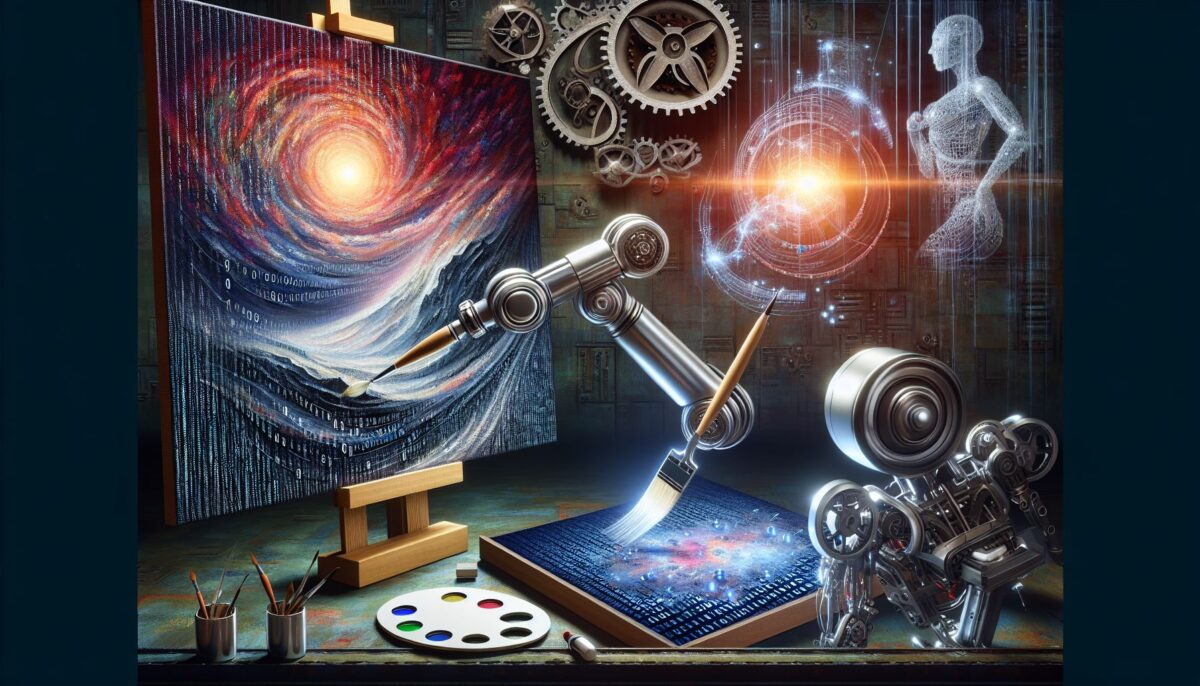
Welcome back, fellow tech enthusiasts, to another day of exploring our techno-utopian future. Today, we’re tackling a topic that’s been stirring up all kinds of conversations in my circles: AI in creative arts. You know, that weird space where artificial intelligence picks up a paintbrush or strums a guitar, blurring what used to be clear lines between technology and pure human inspiration.
Once Upon a Neural Network
Ah, computers and creativity. I remember not-so-fondly when my college creative writing classmates said art and tech would never mix, dismissively eyeing my laptop during poetry readings. (Side note: Think of my poetic magnum opus as “Code Whispers of the Binary Soul.”) Fast forward a decade, and I’ve found myself excitedly explaining to those very classmates how AI is changing everything from painting to poetry. Boy, does art class look different nowadays!
You might be wondering how exactly artificial intelligence fits into a creative studio. At its core, AI in creative arts uses deep learning models, neural networks, and computational creativity algorithms to create, innovate, and even predict human artistic outputs. Remember the hype about OpenAI’s DALL-E, capable of spitting out mind-blowing images from text descriptions? Or how about Jukedeck, which composes music based on algorithms (acquired by TikTok’s parent company ByteDance)? These aren’t just flash-in-the-pan novelties. They might actually change how we think about and make art.
The Algorithms Behind the Easel
Let’s peek under the hood of these incredible AI artists. To put it simply, a lot of the magic happens within neural networks trained on massive datasets. Millions upon millions of images, songs, and texts feed these algorithms, teaching machines what appeals to the human eye or ear, or at least getting close to it.
Remember when Google’s DeepDream turned photos into psychedelic nightmares (I mean, “masterpieces”)? It used convolutional neural networks (CNN) to recognize and enhance certain features. Imagine this on steroids, and you have the new generations of AI models trained not just to perceive art but to create it. GANs (Generative Adversarial Networks) are at the cutting edge, functioning as the dynamic duos of the AI world. One half creates images, the other critiques them. Talk about the ultimate artist-critic combo!
A Canvas of Possibilities
AI isn’t just making art. It’s reshaping the fundamental processes behind artistic creation. Consider the artist Mario Klingemann, a pioneer in AI-generated art. He creates beautiful, often surreal artwork with the help of neural networks. I’ve had the pleasure to chat with coders turned painters, who learned their color palettes through coding libraries rather than art catalogs. Then there’s the world of AI-written novels that challenge the norms of story structure, like “1 the Road” by Ross Goodwin, an AI-driven narrative on America’s highways.
Let’s not skip the fashion industry, where AI’s influence is running wild, predictively suggesting color palettes and patterns for the next season. I’m picturing a future where I let an AI select my daily wardrobe, unleashing the creatively expressive side my programmer tendencies might have missed.
Debating the Soul of the Artist
Of course, any leap in technology brings with it the requisite hand-wringing debates. Does a machine truly create art if it replicates patterns it’s learned from history? The purists argue AI lacks the conscious agency or emotional depth to “truly” create. Meanwhile, I can’t help but chuckle at the thought of humans gatekeeping creativity from their digital siblings. What if the art doesn’t even need an audience?
I’ve heard some describe AI as an endless intern with no sick days or lunch breaks. Cool but a bit unsettling. However, plenty of artists view AI as a collaborative partner, a muse even. Recently, at an NYC tech-art show, I met a digital sculptor who described her relationship with AI as “infinitely inspiring” and “endlessly surprising.” Is it perfect? Of course not. But were any masterpiece-rendering human artists flawless beings? Exactly.
Future Flow: AI and the Next Brushstroke
It’s wild to think where we are and where we’re heading with AI in the creative realm. My bold prediction? In a decade, we’ll see all kinds of AI collaborations: co-paintings with robots, bands mixing human and artificial beats in rhythmic harmony, and novels written by AI using machine logic to craft plot twists even we humans can’t predict.
These prospects come with real challenges: ethical concerns about originality, copyright issues, dependency on AI, and potential social displacement of artists. But let’s walk the line of possibility before reality catches up, shall we?
Wrapping it up, the world of AI-enhanced arts is wild, unpredictable, and genuinely exciting. Whether it’s breathing new life into classical forms or inventing unprecedented genres of artistic expression, we’re smack dab in the middle of a cultural tech renaissance. Here’s to whatever comes next, where every artist, human or machine, gets to splash their distinct color across the universal canvas.
Stay inspired and curious, my friends. Until next time!