The Sleep Crisis Is Real (And It’s Costing Us)
Let’s start with the numbers, because they matter. Over one-third of American adults are sleeping fewer than seven hours per night. That’s not a personal failing. That’s a systemic issue. The economic impact? We’re talking about $411 billion in lost productivity annually across the US economy alone. To put that in perspective, that’s more than the GDP of most countries.
What’s wild is that most people know they should be sleeping more. The problem isn’t knowledge. It’s implementation. We’re caught between knowing sleep matters and actually building lives that permit it. That gap is exactly where high-performance sleep science lives. And here’s the encouraging part: the research isn’t asking you to become a sleep perfectionist. It’s asking you to understand what actually works versus what’s marketing.
Matthew Walker Changed the Conversation (But the Nuance Matters)
When Matthew Walker’s “Why We Sleep” hit in 2017, it shifted cultural consciousness about sleep from nice-to-have to essential infrastructure. Suddenly, sleep was a mainstream health topic. That book deserves credit for making millions of people take sleep seriously for the first time. The neuroscience in there is genuinely compelling. Memory consolidation. Glymphatic clearance. Immune function. The mechanisms are real.
But here’s what a scientist friend told me recently: a book’s power to inspire isn’t the same as a book’s accuracy in every detail. Some of Walker’s claims have been scrutinized by the research community. Some studies he cited have been questioned. Other findings have been replicated robustly. The point isn’t that the book is wrong. The point is that the research is messier than any single narrative can capture. That’s actually good news for you, because it means sleep optimization isn’t about following one rigid protocol. It’s about understanding principles and adapting them to your life.
The Data Revolution: Wearables and What They Actually Tell Us
Devices like the Oura Ring and Whoop have created a new category of sleep optimization driven by personal data. You wake up and see your sleep score. You see your HRV. You see your recovery. This quantification is powerful. It creates feedback loops. People who never paid attention to their sleep patterns suddenly see their sleep in concrete terms. That’s behaviorally valuable.
Here’s the honest part: these devices are measuring proxies, not sleep itself. They’re estimating REM and deep sleep based on heart rate variability and movement patterns. They’re pretty good at it in research settings. In real life? There’s noise. The devices can’t tell if you actually fell asleep or just lay still. They can’t capture every arousal. But that limitation doesn’t make them useless. It makes them useful for a specific purpose: tracking trends over time. If your Oura Ring shows that you sleep better when you avoid caffeine after 2 PM, that’s actionable regardless of whether the absolute sleep numbers are perfect.
The real value is behavioral. People see the data, make changes, and notice improvements. The device becomes a mirror. And mirrors create motivation.
Chronobiology Is Real, and Your Sleep Timing Preference Is Not a Character Flaw
One of the most misunderstood areas of sleep science is chronotype. You know how some people absolutely crush it waking at 5 AM while others can’t string a coherent thought together until 10 AM? That’s not laziness. That’s neurobiology. Your circadian rhythm has a genetic component. Research in chronobiology has consistently shown significant individual differences in optimal sleep timing. Some people genuinely are night owls. Some genuinely are early risers. Forcing yourself into the wrong chronotype is like forcing a night owl to optimize for early morning and then wondering why they’re miserable.
This matters for the high-performance sleep conversation because it shifts the frame from universal rules to individual optimization. The research validates individual differences. That means the best sleep protocol for you might look different from your partner’s, and that’s exactly how it should be. The question isn’t “Am I broken?” It’s “What’s my timing and how do I build my life around it?”
The Tools That Have Evidence Behind Them (And the Ones That Don’t)
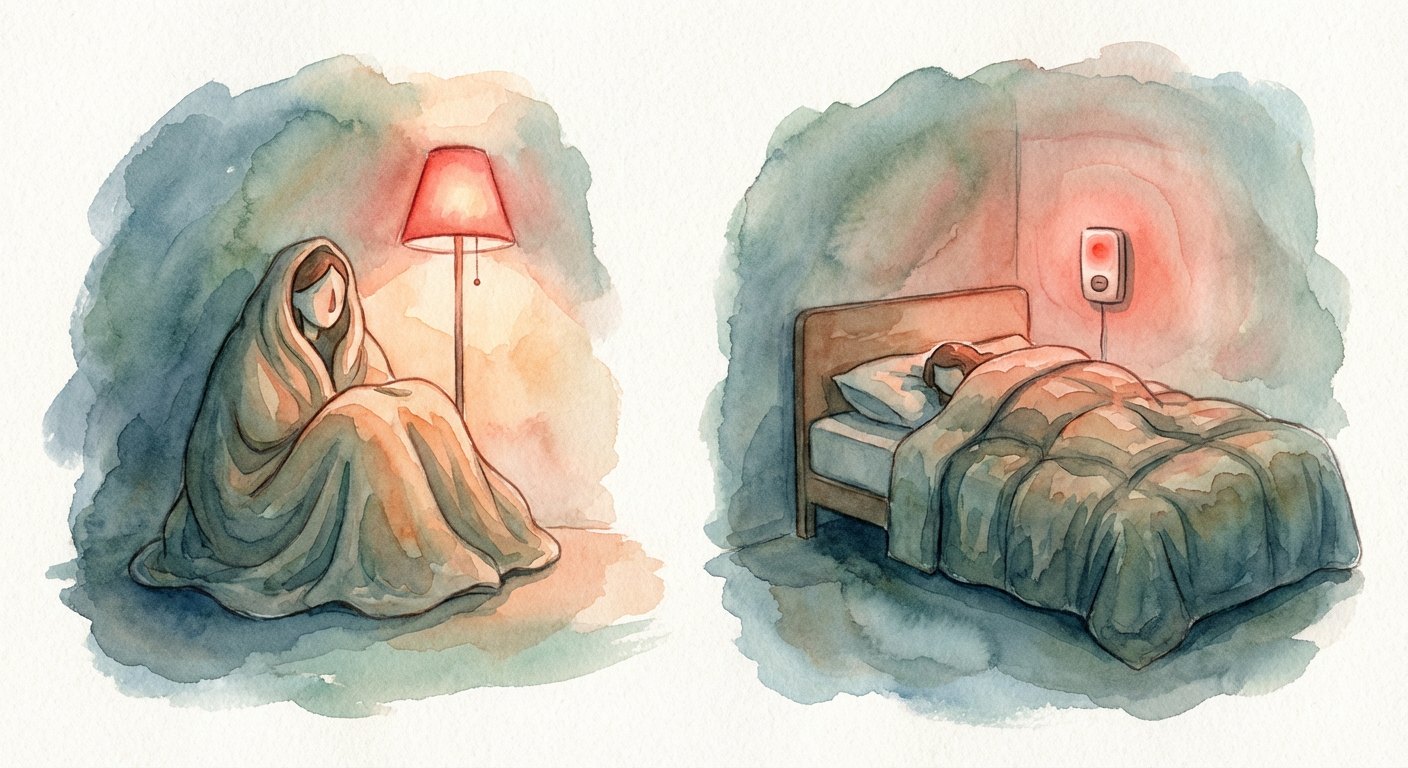
Red light therapy is everywhere in the sleep category right now. You can buy red light panels for your bedroom. The theory? Red light wavelengths support melatonin production and don’t suppress it like blue light does. The research here is suggestive but not overwhelming. Some studies show benefits. Others show minimal effects. It’s not bogus. It’s just not settled. If red light therapy appeals to you, try it and measure your sleep. Track whether it actually changes anything for you. Sleep Foundation research catalogs what’s known and what’s still emerging, which is a useful resource for cutting through claims.
Weighted blankets are in a similar category. They’ve become a phenomenon, particularly for anxiety and sleep. The research suggests they may help reduce cortisol and increase parasympathetic activation. They probably do help some people. Will they help you? That depends on your sensory preferences and what your nervous system responds to. Again, the research is real but not universal.
What does have robust evidence? Consistency. Temperature. Light exposure timing. Exercise timing. Caffeine cutoff. These aren’t flashy. They don’t generate excitement. But they work across populations. Huberman Lab sleep protocols builds on these foundations with detailed implementation guidance. The foundations are boring precisely because they’re reliable.
Building Your Sleep Protocol From Evidence
Here’s what I want you to take from this: the high-performance sleep movement is at its best when it’s grounded in evidence and at its worst when it’s selling you a single answer. Your sleep optimization might include some of these tools. It might include none of them. What matters is starting with the foundation and building from there.
Track what you actually do and what actually changes. Notice your chronotype instead of fighting it. Use data, but don’t worship data. Read the research, but know the difference between what’s proven and what’s promising. And remember that the goal isn’t perfect sleep. It’s better sleep than you’re getting now. That’s enough. That’s achievable.
What part of your sleep is calling for attention right now? I’d genuinely love to hear what you’re noticing about your own patterns and what you’re curious about exploring.